We provide affordable rental of Home Practice Materials for children from 3 months to 3 years. For the other 6 days, parents need to buy materials for Home Practice, but that may be pricey and need lots of storage space. By renting and not buying, you save space and money, but most importantly, you get to use different Home Practice materials for your child, that will make him stay interested in your Home Pracice session.
Showing posts with label Fine Motor Skills. Show all posts
Monday, 23 May 2011
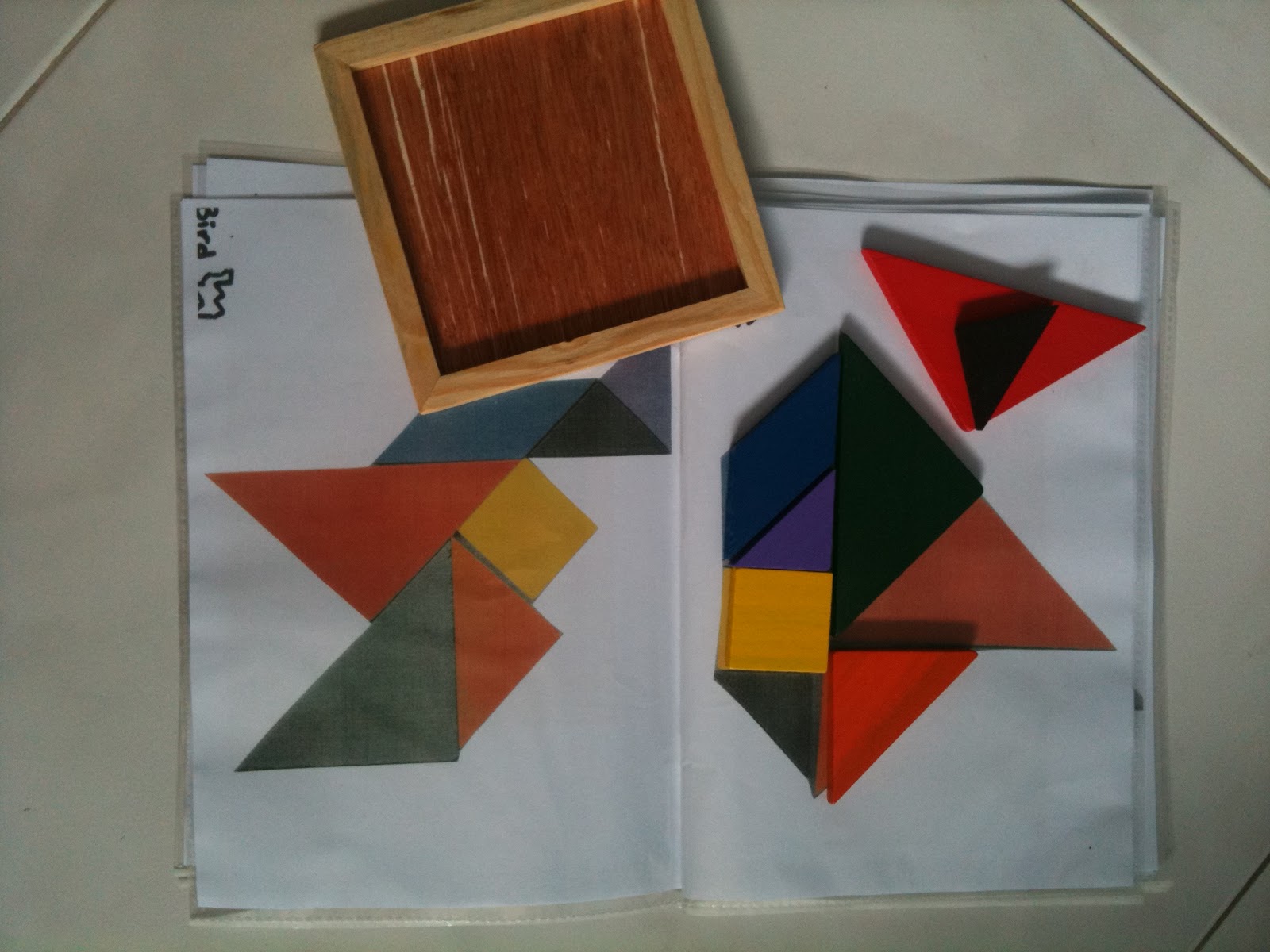
Home Practice - Tangram
What is it?This is a very common game - Tangram - where the child is to use the 7 shapes to make a big picture. As the child engaging in this game is expected to be within the age of 3 months to 3 years, the big pictures will be shown to the child in colours with the breakdown of the shapes shown.
How to make it yourself
Using a piece of foam, draw out the shapes and cut it out. Preferably, use different coloured foams to allow easier differentiation. However, it is important that the size of the shapes must be drawn to almost perfection.
You may find pictures made using the Tangram shapes online for your reference.
What purpose does it serve?
By arranging the pictures in the same arrangement as the worksheets, the child needs to use his Visual-motor skills and fine-motor to pick up and arrange the shapes.
Visual Spatial-relations skills will also be needed to understand the shape and deciding when to flip it or turn it to fit the worksheet.
As some shapes are similar, Visual Discrimination, which is the ability to notice subtle differences, will be activated to differentiate the size of the shapes, especially the triangles in order to place them in the correct position.
When the child is asked to see the arrangement, he is trained in his Visual Figure-ground, which is the ability to attend to one activity without being distracted by other surrounding activity.
You can make use of the exercise to introduce shapes and colours to the child.
Summary of developmental objectives
Visual-motor, Visual discrimination, Visual figure-ground, Visual Spatial-relations, Fine-motor, Logic, Tactile, Proprioceptive.
Home Practice - Stringing
What is it?
This is a game where the child has to string the lace through the holes in numeric sequence to make a design for the mask. The one shown here is for a clown. There are various other designs available.
How to make it yourself
The items we carry were purchased. However, you can get a thick cardboard or plastic materials from the Art shop, cut it in a shape you desire, and use hole puncher to punch out the places where you want the child to string the lace.
What purpose does it serve?
By stringing to make the design, he is making use of his fine-motor skills and visual-motor skills to hold the lace and insert it into the holes.
He also makes use of his Sequential skills to decide on which hole to insert the lace, as there are numbers beside the holes to guide the child.
After finishing the stringing task, the child engages in pretend play, which is important for the social and emotional development of the child, to wear the mask and pretend he is the person/animal. He can also use this to express his affection.
When the child is asked to perform this task of stringing, he is trained in his Visual Figure-ground, which is the ability to attend to one activity without being distracted by other surrounding activity. This is especially so in this case as this is an activity that takes slightly longer time and visual muscle.
The child may also learn the concept of 'in' and 'out', 'up' and 'down', and 'into' while stringing. This helps in his language skills.
Summary of developmental objectives
Visual-motor, Visual sequential, Visual Figure-ground, Fine-motor, Social/emotional development, Tactile, Language, Proprioceptive.
Wednesday, 20 April 2011
Home Practice - Feed the animals
What is it?
This is a game where the child has to 'feed' the animal with food. Careful! Don't put your fingers inside the mouth or the animal may bite you!
How to make it yourself
This is a game which is made using plastic food container. The cover is partially cut to act as the 'mouth' of the animal, and a picture of the face of the animal is drawn and pasted on the cover. Pieces of sponge (cut out from dish-washing sponge) or furry balls as shown in the picture above, will act as the food.
Chopsticks or squeezers may be used as the cutlery in older children.
What purpose does it serve?
By pretending that the animal is real, the child engages in pretend play, which is important for the social and emotional development of the child. It is important for the child to be able to understand what other beings, apart from himself, think and feel.
By feeding the animal, the child understands that animals are like us, they go hungry and need food too! That brings in empathy in the child and the child can learn to be considerate and offer food.
By not putting the finger into the mouth of the animal while feeding it, the child understands that there are certain danger involved in interaction, and there are invisible boundaries. If the child crosses the boundary (in this case, the animal's mouth), he may be putting himself in danger (of being bitten by the animal). Although there are tamed animals, it is important to understand that, just as well as he doesn't like the doctor sticking the thermometer into his mouth, the animals may also feel threatened if he sticks his fingers into its mouth.
By picking up the food, the child is using his fine motor skills to grab the food. He is also using his visual muscles to see the food, his visual-motor skills to bring his finger to the food so he can grab it. He uses the same visual-motor skills to bring the food accurately to the position of the mouth, and activates his fine-motor to release the food at the right time to drop it into the animal's mouth.
For older children, cutlery such as chopsticks/squeezers may be used.
The child may also feel the texture of the 'food' and imagine what the food might be, such as carrot for rabbits, corn for pigs etc. This further stimulates that imaginative skills and logic development in children (e.g. understand that rabbits are herbivore and therefore he can't be feeding meat to the rabbit)
While feeding, the child may count the number of pieces of the food, and this also helps develop the counting skills and recognition of numbers (sound) (Auditory discrimination). You may wish to conduct the counting in various languages to expose the child to more languages.
Summary of developmental objectives
Visual-motor, Visual, Fine-motor, Counting, Social/emotional development, Imaginative skills, Tactile, Logic development, Auditory discrimination, Proprioceptive.
This is a game where the child has to 'feed' the animal with food. Careful! Don't put your fingers inside the mouth or the animal may bite you!
How to make it yourself
This is a game which is made using plastic food container. The cover is partially cut to act as the 'mouth' of the animal, and a picture of the face of the animal is drawn and pasted on the cover. Pieces of sponge (cut out from dish-washing sponge) or furry balls as shown in the picture above, will act as the food.
Chopsticks or squeezers may be used as the cutlery in older children.
What purpose does it serve?
By pretending that the animal is real, the child engages in pretend play, which is important for the social and emotional development of the child. It is important for the child to be able to understand what other beings, apart from himself, think and feel.
By feeding the animal, the child understands that animals are like us, they go hungry and need food too! That brings in empathy in the child and the child can learn to be considerate and offer food.
By not putting the finger into the mouth of the animal while feeding it, the child understands that there are certain danger involved in interaction, and there are invisible boundaries. If the child crosses the boundary (in this case, the animal's mouth), he may be putting himself in danger (of being bitten by the animal). Although there are tamed animals, it is important to understand that, just as well as he doesn't like the doctor sticking the thermometer into his mouth, the animals may also feel threatened if he sticks his fingers into its mouth.
By picking up the food, the child is using his fine motor skills to grab the food. He is also using his visual muscles to see the food, his visual-motor skills to bring his finger to the food so he can grab it. He uses the same visual-motor skills to bring the food accurately to the position of the mouth, and activates his fine-motor to release the food at the right time to drop it into the animal's mouth.
For older children, cutlery such as chopsticks/squeezers may be used.
The child may also feel the texture of the 'food' and imagine what the food might be, such as carrot for rabbits, corn for pigs etc. This further stimulates that imaginative skills and logic development in children (e.g. understand that rabbits are herbivore and therefore he can't be feeding meat to the rabbit)
While feeding, the child may count the number of pieces of the food, and this also helps develop the counting skills and recognition of numbers (sound) (Auditory discrimination). You may wish to conduct the counting in various languages to expose the child to more languages.
Summary of developmental objectives
Visual-motor, Visual, Fine-motor, Counting, Social/emotional development, Imaginative skills, Tactile, Logic development, Auditory discrimination, Proprioceptive.
Subscribe to:
Posts (Atom)